Find Us
Online Store
Ships throughout Malaysia
Pop-up Events
Locations announced on Instagram
Work Hours
Monday to Friday: 10AM - 8PM
Weekend: 10AM - 8PM
Find Us
Online Store
Ships throughout Malaysia
Pop-up Events
Locations announced on Instagram
Work Hours
Monday to Friday: 10AM - 8PM
Weekend: 10AM - 8PM

Choosing the best natural perfume notes for everyday wear is less about chasing the most complex scent and more about picking notes that stay pleasant through work, commuting, and Malaysia’s heat. In most cases, lighter citrus, floral, green, and soft woody notes are the safest starting point for daily use.
TLDR: Summary
- The best natural perfume notes for everyday wear are usually bergamot, neroli, lavender, petitgrain, tea, rose, geranium, and light woods like cedarwood because they smell cleaner, feel less dense, and suit daytime use.
- Top notes, middle notes, and base notes are defined by volatility: top notes are smelled first, middle notes form the heart, and base notes last longest. For daily wear, lighter top and middle notes usually feel easier than heavy resins or very sweet bases.
- A natural perfume is not automatically safer. IFRA states natural or organic labelling does not guarantee safety, and FDA identifies fragrances as a common cosmetic allergen class.
- If you have sensitive or eczema-prone skin, safety depends more on your exposure and allergen sensitivity than on the word “natural”. Patch testing and careful label reading matter.
- In humid Malaysian weather, lighter citrus-floral or green-herbal blends usually wear better than dense vanilla, oud, or resin-heavy scents.
- If a label only says “fragrance” or “perfume”, ingredient detail may be limited. If you react easily, fragrance-free products may be the better choice for routine skin contact.
That practical balance matters because everyday perfume has to work on skin, in shared spaces, and across long wear. Note structure explains why some scents feel airy and easy at 9am but too heavy by 3pm, while safety guidance from IFRA and FDA explains why “natural” should never be the only filter.
A good everyday natural perfume usually relies on bergamot or lavender plus a soft heart note, not a dense resin-heavy base. Wearability comes from balance, low scent fatigue, and how the note behaves over several hours.
For daily use, the best note families tend to be those that feel clear rather than crowded. You want a scent that reads clean at close distance, does not bloom too aggressively in heat, and still feels appropriate in the office, car, train, or café. That usually means moderate projection, familiar note shapes, and a base that supports rather than dominates.
A common mistake is to judge only the opening. The first ten minutes may be bright and lovely, but if the dry-down turns sweet, smoky, or sticky in humidity, it may not be an everyday match. Good daily wear is really about the full arc of the fragrance, not just the first impression.
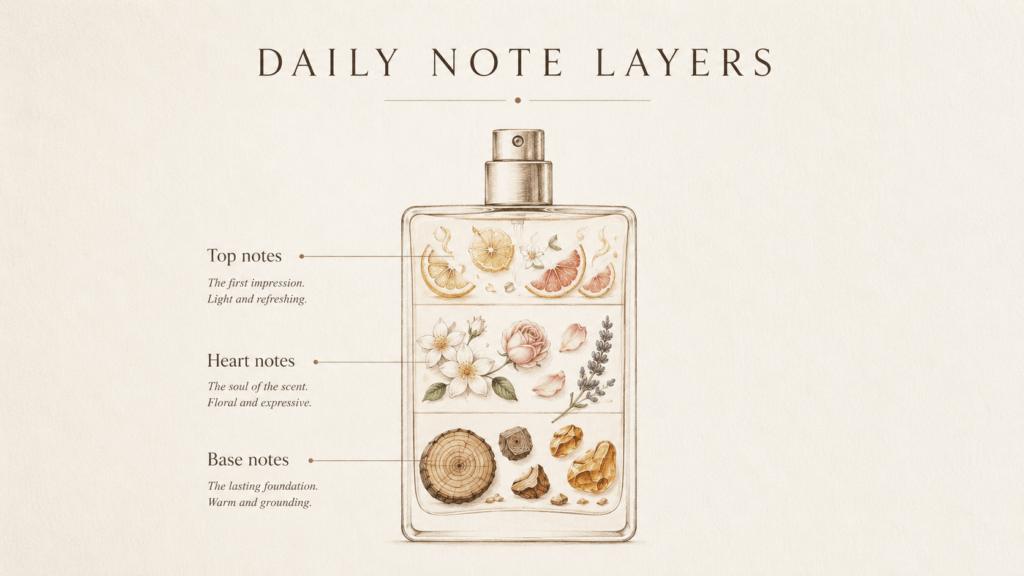
IFSCC and IFRA support the same core idea: fragrance notes behave by volatility. Top notes lift first, middle notes shape the heart, and base notes last longest.
Top notes are the most volatile, so they are smelled first and often include citrus materials. Middle notes are less volatile and give the perfume its character after the opening settles. Base notes are the least volatile, so they stay on skin the longest and often determine whether a perfume feels light, creamy, woody, resinous, or heavy by the end of the day.
This matters for everyday wear because many people choose perfume based on the opening, then feel surprised when the later phase is much stronger. If you want a daily natural perfume, it is often smarter to prioritise an easy top and heart with a restrained base. A soft cedarwood base behaves very differently from a thick balsamic or animalic-style dry-down.
“YRU Organic uses pure essential oils in its natural perfumes, which is useful when you want a natural perfume with clearly recognisable note families rather than a crowded scent profile.”
The best everyday natural perfume notes are usually citrus, neroli, lavender, tea, rose, geranium, and light woods. They tend to smell fresh, calm, and socially easy to wear.
If you are choosing blind, start with note families that have a proven daily-wear profile rather than the boldest niche style. These options are usually the easiest entry point:
The safest blind-buy logic is simple. If you want freshness, start with bergamot or neroli. If you want calm, try lavender or tea. If you want a little structure, add a light wood. Many people think “more base note” means better value, but for daily use it often means more fatigue.
In Malaysia, neroli and bergamot usually outperform thick vanilla-style or resin-heavy scents for daytime wear. Heat and humidity can make sweet or dense notes feel louder than expected. Bedfan explains why humidity makes heat feel stronger by slowing evaporation, a microclimate effect that also makes diffusive, sugary accords read louder on skin and in the air.
Step 1 is to judge the dry-down in real weather, not only in air-conditioned settings. Spray once, leave the shop or test area, and pay attention after 20 to 60 minutes. If the scent feels sticky, overly sweet, or too diffusive outdoors, it is probably not your easiest everyday option.
Step 2 is to limit concentration by application style. One spray on the chest under clothing may feel better than multiple sprays on exposed pulse points. This is a useful pro tip in humid climates because projection often matters more than raw longevity.
Step 3 is to choose note families that age well through heat. Citrus-floral, herbal, tea, and dry wood structures usually stay clearer than syrupy gourmands or dense ambery profiles. If your office or commute involves close contact, skin-scent territory is often the smarter choice.
YRU Organic is available online nationwide and at pop-up events, which is practical when you want to test a natural perfume on skin and in real Malaysian weather before choosing an everyday note family.
The main difference is source and formula design, not automatic safety. IFRA and the FDA both make it clear that fragrance sensitivity depends on ingredients and exposure, not on a “natural” label alone.
Natural perfume usually centres botanical materials like essential oils, absolutes, and natural-derived ingredients. Conventional perfume may combine natural materials with synthetics for stability, projection, and consistency. Neither category is automatically better for every person.
The key trade-off is this: natural perfumes often feel more textured, airy, or plant-like, but they may change faster on skin and can be less consistent batch to batch. Conventional perfumes can offer more precise performance and longer-lasting structure. If your goal is everyday comfort, the right question is not “natural or synthetic?” but “which ingredients, at what dose, and how does my skin respond?”
“Your skin doesn’t read marketing labels.”
A common misconception is that “chemical-free” means safer. IFRA explicitly says that claim is misleading because everything, including water, is a chemical substance. The practical filter is tolerance, not buzzwords.
For most people, citrus-floral and green-herbal blends are easier for daily wear than deep woody-resinous perfumes. Neroli and lavender usually feel more versatile at work than heavy patchouli or oud-style accords.
Citrus-floral perfumes give quick freshness, a clean emotional tone, and better daytime flexibility. They are ideal if you want a scent that feels polished but not dramatic. Their trade-off is shorter obvious wear, especially when the top note fades quickly.
Warm woody perfumes offer more body and staying power. They can feel grounding and sophisticated, especially in evening settings or cool indoor spaces. Their trade-off is that in heat, they may feel denser, sweeter, or more serious than you intended.
If you want one bottle for frequent wear, citrus-floral usually wins. If you want character and a slower dry-down, choose a light wood with citrus on top rather than going straight to smoky, syrupy, or resin-heavy territory.
A patch test should be done on a small area before regular wear, especially with essential oils and on eczema-prone skin. The goal is to catch irritation early, not to prove that a perfume is universally safe.
Step 1 is to apply a very small amount on a limited area like the inner forearm. Do not test on broken skin, active eczema, or freshly shaved skin. Then leave it alone and watch the area for at least 24 hours.
Step 2 is to check for signs like itching, redness, burning, or a rash. The FDA notes that allergic reactions to cosmetics often appear as itchy, red skin rashes or contact dermatitis. If you notice any of these, wash it off and stop using the product.
Step 3 is to repeat cautiously before full wear if you are highly reactive. A single uneventful test is helpful, but repeated exposure is what sometimes reveals sensitivity. If you already know you react to fragrance, patch testing is not a substitute for medical advice.
Start with the ingredient list, then check how much detail the brand gives about essential oils and the term “fragrance”. The FDA notes that some fragrance ingredients may appear only under a general fragrance declaration.
Step 1 is to separate marketing from formula facts. “Natural”, “organic”, and “botanical” describe positioning, but they do not confirm that every aromatic material will suit your skin. IFRA also states that natural or organic labelling does not automatically mean non-irritating or non-allergenic.
Step 2 is to look for specific material names where possible. A brand that names lavender, bergamot, cedarwood, or other essential oils gives you a clearer starting point than a label that only says perfume. If you already know a trigger, specific naming helps you avoid it.
Step 3 is to watch for the phrase “natural-derived” as well. IFF notes that ISO 16128-1 defines natural-derived ingredients as being greater than 50% natural origin by molecular weight or renewable carbon content under defined processes. That term is not the same as 100% natural, so it is worth reading carefully.
“YRU Organic focuses on plant-based formulations and pure essential oils, so label reading should still centre on the exact aromatic materials, your skin tolerance, and how often you plan to wear the perfume.”
The best everyday perfume is not necessarily the one that lasts the longest. It is the one that remains comfortable from morning to evening without becoming distracting to you or the people around you.
Pay attention to how the perfume develops after the first 30 to 60 minutes rather than judging it from the opening alone. Citrus and green notes may fade quickly, while woody and resinous notes often become more noticeable as the scent settles on the skin.
If you wear perfume in Malaysia’s warm and humid climate, choose a scent that still feels balanced after spending time outdoors. A perfume that feels fresh in an air-conditioned shop can become much richer once exposed to heat and humidity.
Ultimately, an everyday natural perfume should feel comfortable enough that you enjoy wearing it repeatedly, whether you’re commuting, working, meeting friends, or relaxing on weekends.
If you have a known fragrance reaction, active dermatitis, or repeated unexplained rashes, fragrance-free is often the better choice than any perfume, including natural perfume. The FDA specifically advises concerned consumers to check labels carefully and consider fragrance-free products.
This is especially relevant if you are rebuilding a damaged skin barrier, using strong actives, or trying to isolate the cause of irritation. In those cases, the smartest move is not to keep switching scent families. It is to remove the fragrance variable altogether for a period.
Also note that fragrance-free and unscented are not always the same in everyday shopping language. If your skin is highly reactive, read the ingredient declaration rather than relying on the front label alone. That is often the fastest path to clarity.